Understanding Ephesians 5:22-32 – The Three Parts and the BIG IDEA
May 2, 2026 | All Posts
Wives subordinated? Husbands like Christ? These ideas are claimed to come from Ephesians 5 but they really aren’t found there. It is time to look more carefully at these verses. What is actually going on in the 11 verses of Ephesians 5:22-32?
Let us focus on what the Apostle Paul had in mind. Let us follow the three-part “as Christ” sections he wrote into this passage. They are found in verses 22-24, 25-27 and 28-31.
There are different ideas in each of the three sections of Ephesians 5:22-31. First, we will look at those. Then we will zoom out a bit and check the context of these verses in the whole passage of Ephesians 5:15 to 6:9 to see if we have understood the major and minor messages in Paul’s patterns to the Ephesians.
“As Christ” are the key words in the three sections of these 11 verses. They help us recognize the three sections that make up verses 22-31. Together, these three sections point to the major truth that comes in verse 32. That is: He and we are one!
Here are the main ideas in the linchpin of verse 25b and in the summary in verse 32. Christ’s love in 25b links down to individual care of one’s body. Christ’s sacrifice in 25b links back up to mutual care of one another.
Ephesians 22-24: Horizontal care for one another involves sacrificial investment too, “as Christ”
Ephesians 25-27: We should love and sacrifice “as Christ” loved and gave himself for the church
Ephesians 28-31: Individuals lovingly care for their own bodies, “as Christ” loved
Ephesians 32: We together along with Christ make up one united functioning body
Notice how Paul introduces each section. First with “wives” (verse 22), then with “husbands” (verse 25), finally after starting with husbands and wives in verse 28 he lands on “individuals” or “no one” (verse 5:29)
The first section, verses 22-24. This is a four-part parallelism in an A, B, B prime (B’) and A prime (A’) pattern. The two A parts, in 22 and 24, go together. The two B parts in 23a and 23b go together. The two outside parts are filled with the actions found in verse 21. This is because verse 22 has no verb! According to Greek usage the reader looks back to the verb used just before and uses that verb again. Interestingly the action in verse 21 is of horizontal submission, of mutual disciple building, of reciprocal care and correction by the members of the body of Christ.
When Paul writes “wives … to your husbands” he is not writing to wives alone. He has in mind Spirit-filled wives (see 5:18b), who are teaching and correcting their husbands (19a) and who likewise are being taught and corrected by their Christian husbands while each is submitting (21) to what they are receiving from the other.
This is mutual care and submission. This is horizontal body life. In the B and B’ parts in verse 23 Paul adds to this picture of horizontal harmony. He says it is like the parts of the body that when united and functioning well lead to healthy living. Both the husband and the wife are part of a one-flesh unity (see 5:31). In the same way, all we who are Spirit-filled are united in one body with Christ. He is one part and we are the other part. Together we make up one functioning body, the church.
One more detail is important to notice. This costs something. For Christ it cost everything. Verse 23b ends with these words, himself savior of the body.
Verses 22-24: Mutual care that involves investment “as Christ”
The second section, verses 25-27. This section has a unique element in the second half of verse 25 that links it with the other two sections. It is called a linchpin in which two key words are linked to the sections on either side. A linchpin in the Bible was first used in parallel sections in Genesis 2-3.
In the Genesis 3 linchpin occurrence, in Genesis 3:15-17, it linked God’s words to the woman in 3:16 about “hardship” (’itsabon), per Ingrid Faro in Redeeming Eden, with God’s words to the man in 3:17 and about conception (heron) with God’s words to the serpent in 3:15 regarding her “offspring” (zera’).
In the Ephesians 5:25b linchpin occurrence the two linked actions are: as Christ “loved” and “gave himself.” Loving points down to section three in verses 28-31 which make use of the illustration of how a person loves and cares for their own physical body. Giving himself points back up to section one in verses 22-24 which elaborates on how believers reciprocally build up one another (22, 24), makes use of a joint-body metaphor (23a and 23b) and points to how sacrifice is involved as all the parts of the body build up one another, especially in the way Christ gave himself as Savior.
Then in the remaining words of the middle section, in verses 26 and 27, Paul elaborates how Christ loves the church with agape love.
Verses 25-27: as Christ loved and gave himself for the church
The third section, verses 28-31. This is a four-part parallelism in an A, B, B prime (B’) and A prime (A’) pattern. The two A parts, in 22 and 24, go together. The two B parts in 23a and 23b go together. The two outside
Verses 28-31: a person lovingly cares for their own body, as Christ loved
The center section, verse 32. The great mystery now revealed is that all of us who are born again (Ephesians 1:1) and Spirit-filled (Ephesians 5:18b) are united with one another and united with Christ in one body. This interrelationship involves self-care for the various parts and deep love as demonstrated by Christ.
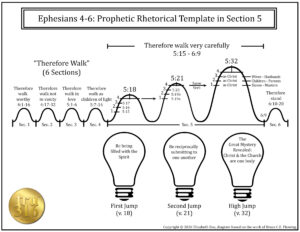
The big pattern. If we take a verse here or there out of context we fail to pay attention to the passage it is in. This context with its limits and patterns also defines the words in a verse in addition to definitions of single words. This passage starts at Ephesians 5:15 and flows all the way to Ephesians 6:9. This is the fifth “walk” or “live” section in Ephesians 4-6. Paul sets it apart from the other five sections by saying “walk very carefully.”
The big parts of the pattern. This passage uses the pattern of a prophetic rhetorical template. These are found in the Old Testament and elsewhere in the New Testament. It is composed of three “jumps.” The first two lead into each other and then into a high jump which has the main idea of the passage in it. This main idea is found at the top, or center, of the high jump.
The first “jump” starts in verse 15 and runs through verse 18. It is a series of contrasts where Paul writes four times, don’t do that but do this. The final “this” is the main idea in this first “jump.” It is, “Be filled with the Spirit (Eph 5:18b).
The second “jump” starts with verse 19a and runs through verse 21. This “jump” explains how one behaves when they are filled with the Spirit. Here, Paul leaves behind the pattern of contrasts used in the first “jump” and he uses constructive parallelism to pair or complete two ideas in four short lines. We often fail to see this because the first two short lines were sadly lumped together in just one verse, in verse 19. The four parts of the parallelism can be numbered as follows – Part A is verse 19a, Part B is verse 19b, Part B Prime is verse 20 and Part A Prime is verse 21. Thus, what is in Part A is mirrored or competed in Part A Prime. Part B is mirrored or completed in Part B Prime.
The two B parts in the constructive parallelism point upward. They talk about praising God. The two A parts in the parallelism point outward. They talk about how to interact with “one another.” If we look closely we can see the pattern in these verses.
Thus, if we want to know about “submission” in the Part A Prime “one another” part, verse 21, we need to see what it is paired with in verse 19a. Interestingly the action in verse 19a is stated with more detail in the related verse in Colossians 3:16. The whole idea of A and A prime is this. Believers who are filled with the Spirit teach and correct one another from the Word (Eph 5:19a and Col 3:16). At the same time believers submit to the teaching and correction they are receiving from one another in Christ.
One more observation needs to be made about this pair of A lines. Usually submission has to do with vertical relationships. In vertical submission the one who is under someone submits to the one who is over them. Paul radically substituted this with horizontal submission. In the case of Spirit-filled, “one another” horizontal submission, Spirit-filled believers were building up one another and they in turn were accepting, submitting, benefitting from the teaching and correction they were receiving in Christ.
The “high jump” is where the flow of thought in the fist two jumps has been leading. It is a complex chiasm of three parts leading up to the main idea in the middle and three more parts pointing back to the main idea again. The parts leading to the center are as follows: verses 22-24, 25-27 and 28-31. The parts pointing back at in 5:33. 6:1-4 and 5-9.
The three parts leading to the center focus on how Christ loved and gave himself to the church, as mentioned earlier. The three parts pointing back to the center focus on how Christ impacts the relationships in the household of Paul’s day. Three pairs of relationships are mentioned. In each pair they individuals are acting in the reciprocal way described in the first jump in verses 19a and 21. Spouses build up one another in Christ. So too do parents and children and masters and servants.
Go deeper? More detail is given in the book Beyond Eden, Ephesians 5:15-6:9 which has the subtitle “The Great Mystery Revealed: Mustually Submitting in Christ.” It is available in print and as an eBook on Amazon and also as an audiobook on Audible.
by Bruce C. E. Fleming with input from various members of the Tru316 Foundation Tru School Advanced Course and from the members of the Agape Class at First Evangelical Free Church, Minneapolis, Minnesota.